Reviews
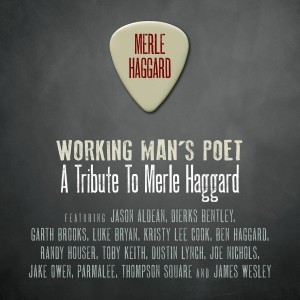 Broken Bow Records has got something special for all the Merle Haggard fans. Actually, what they have is something special for all country music fans. On April 1, Working Man's Poet: A Tribute to Merle Haggard will be available in stores, and through digital outlets. The album has 20 of Merle's songs, performed by some of the biggest names in country music today.
This is a great way to pay tribute to Merle, and at the same time, introduce his music to today's listeners. The songs are being sung by artists that new country music fans hear on the radio every day. Fans of Luke Bryan, Randy Houser, Joe Nichols and others will enjoy this album. While they are listening to some of their favorite artists, they will also have what might be their first opportunity to hear the great country music of Merle Haggard.
Merle Haggard was the first ACM Entertainer of the year back in 1970. In 1965 he won Most Promising Male Vocalist of the Year, and won his first of six Male Vocalist of the Year awards in 1966. He joined the Country Music Hall of Fame in 1994.
On April 6, the 49th annual Academy of Country Music awards will be broadcast live on ABC (8-11 p.m.). This year, Merle will be receiving the Crystal Milestone Award. Past recipients of this award include Garth Brooks, Kenny Chesney, Jason Aldean, Jennifer Nettles and Taylor Swift.
The songs you will hear on the new album include Misery and Gin, performed by Randy Houser; Footlights, performed by Joe Nichols; Going Where the Lonely Go; performed by Jason Aldean; Today I started Loving You Again, performed by Kristy Lee Cook; Carolyn, performed by Toby Keith; Pancho and Lefty, performed by Luke Bryan and Dierks Bentley; Tonight the Bottle Let Me Down, performed by Garth Brooks, You Take Me For Granted, performed by Thompson Square, Mama Tried, performed by Ben Haggard; That's the Way Love Goes, performed by Dustin Lynch; Make Up Faded Blue Jeans, performed by Jake Owen; I'm a Lonesome Fugitive, performed by James Wesley; Workin' Man Blues, performed by Parmalee; Are The Good Times Really Over, performed by Jason Aldean; Let's Chase Each Other Around the Room, performed by Thompson Square; I Think I'll Just Stay Here and Drink, performed by Dustin Lynch; The Fightin' Side of Me, performed by James Wesley; My Favorite Memory, performed by Joe Nichols; Ramblin' Fever, performed by Randy Houser; and Sing Me Back Home, performed by Ben Haggard.
Luke Bryan and Dierks Bentley team up for Pancho and Lefty, the Townes Van Zandt song that Merle and Willie Nelson took to the top of the charts back in 1983. Jason Aldean took on two of Merle's hits from the early 80s, Going Where the Lonely Go and Are the Good Times Really Over. Randy Houser lends his powerful vocals to Ramblin' Fever and Misery and Gin. From the first song to the last, this album is everything you would expect it to be.
I can't imagine having a country music album collection without this Tribute to Merle Haggard being part of it. You get the best of both worlds with one. Today's artists delivering yesterday's hits. It's a good album, and it is going to spend a lot of time in my CD player. I think it will in the player of every country music fan as well.
Keep up with the latest country music news and reviews at www.countryschatter.com. And be sure to follow us on Twitter, too, @countryschatter.
 Blue Ruin consists of 12 selections composed and performed by the Colorado based group, Head for the Hills, including 10 vocal cuts and 2 instrumentals.
The opening cut, Take Me Back, is reminiscent of an early Country Gazette-style offering, particularly with respect to the rhythm style and vocal arrangement.
Though there’s no banjo on this cut, it would otherwise suggest that a regimen of modern Bluegrass fare might be forthcoming. However, with the opening of the next cut, Never Does, you know you’ve stumbled onto something exotic indeed.
Never Does’ feel is more like modern Indie/Grunge merged with Bohemian Gypsy music, complete with train-whistle style background harmonies.
That said, Never Does is brilliantly seductive, as is the title cut, Blue Ruin, which starts out harmless enough, with guitar rhythm and solo vocals, followed by nice violin and guitar fills. But, just when you thought you were safe, the delicate tintinnabulations of electric piano start sneaking out from your speakers to remind you (in case you momentarily lapsed into a coma) this is not your grandpa’s string music.
Priscilla the Chinchilla is one of two instrumentals that serve to establish to the listener that these guys are serious musicians. Michael Chappell’s mandolin chops are especially strong, and obvious, on this cut, as is his taste in note choices and rhythms.
One of my favorite cuts is Wish You Well, with its persistent undercurrent of swelling jazz lines and chopped rhythms complimenting the vocals. It also has a few of those magical moments when you’re sure you’re hearing something both unique and cool.
If Dependency Co.’s clever lyrics aren’t enough to reassure you that you’re in uncharted string-music waters, the trumpet solo should do it. That effort, for the record, comes off really well. Overall, Head for the Hill’s ability to tastefully integrate horns into their recordings is a testament to their very capable production skills.
Another of my favorites from this project is Bosun Ridley, a dark tale of maritime tragedies. Joe Lessard’s violin layered with Matt Loewen’s bass is a particularly effective haunting touch, as are some of the special effects, all tastefully rendered.
Read the rest of this interview at Prescription Bluegrass's website: http://prescriptionbluegrassreviews.blogspot.com/2013/06/prescription-bluegrass-reviews-head-for.html
 Cole Swindell recently released his self-titled, debut album. This is a CD fans have been waiting for since Cole's first single, "Chillin' It", started climbing to the top of country music charts. That single has been certified Gold by the Recording Industry Association of America and Music Canada.
Northeast Tennessee fans had an opportunity to see Cole in concert, when he opened for his Georgia Southern University fraternity brother, Luke Bryan, at Thompson-Bolling Arena in Knoxville. Luke had something to do with Cole's start in country music. For three years, Cole Swindell was Luke's merchandise guy, selling Luke Bryan CDs and tee-shirts at all of his shows.
Cole is about as normal, and down-to-earth as any neighborhood kid in a ball cap. He said that he didn't think he was cut out to be an artist. "I was worried I didn't have a cool story, cause I didn't start off singing when I was a kid," Cole said. But for Cole, the story of his college years and not being a superstar as a child isn't nearly as important as the story he tells with his music.
Like most of today's country artists, Cole didn't just wake up one morning and find himself a success. He has been working at this for more than six years, and has spent a lot of time writing. One of the hits he co-wrote was "This is How I Roll", with Florida Georgia Line's Tyler Hubbard and Brian Kelley.
He tells us that "Hey Y'all is a song he has been opening his live shows with. It's a fun song, and one he said came from an idea he had watching concerts. "I can imagine being in an arena and singing a song and making everyone wave, and thought this was just a cool, party song. It has good lines that I think people will remember," Cole said.
"I Just Want You" is the one Cole describes as the love song on this album. He co-wrote this one with Luke Bryan and Michael Carter. Cole said it's a special song to him, it is just 'straight-up feelings, nothing about back roads or moonlight. The song is from an artist’s point of view, but Cole believes it could really be sung by any guy to his girl. It's about love, and trust.
About his current hit, “Chillin’ It”, Cole said there wasn't really much of a story behind that one. He came up with a title, took it to his co-writer. They got the melody and one line, and just went from there.
The 12 songs on Cole's new album are Hey Y'all, Chillin' It, Swayin', Hope You Get Lonely Tonight, Let Me See Ya Girl, Ain't Worth the Whiskey, Brought To You By Beer, I Just Want You, Get Up, A Dozen Roses and a Six Pack, Down Home Boys and The Back Roads and the Back Row.
All of the music on this CD is good. The music is modern enough that radio stations playing country music’s Top 40 will air it, but it is still close enough to real country that traditional country music fans will enjoy it.
You can keep up with all the news about Cole at www.coleswindell.com, and follow him on Twitter @coleswindell. Find out what all your favorite country artists are doing with the music news and reviews at www.countryschatter.com, and follow us on twitter @countryschatter.

Date = 4 March 2014
Artist Name = Ben Stolorow and Ian Carey
Genre = Jazz
Title = Duocracy
Record Company = Kabocha
Review =
Inventive and pretty, the music on Duocracy (recorded in 2013) is reminiscent of that created by Ruby Braff and Dick Hyman on several albums, including Play Nice Tunes (1994), though Braff usually performed on cornet while Ian Carey plays trumpet. Pianist Ben Stolorow and Carey mostly favor tunes from what is often called the Great American Songbook, ones similar to those Braff and Hyman played occasionally. Jazz writers who decry musicians’ continued interest in such music should listen to Stolorow and Carey’s fresh treatment of standards.
Ranging chronologically from the Gershwins’ “How Long Has This Been Going On” and Rodgers and Hart’s “You Took Advantage of Me” (both 1928) to Henry Mancini’s “Two for the Road” (1967), seven of the ten selections are well known. The tempos range from sprightly to deliberate. The briskest selection, “Cherokee” begins with a brief fanfare, as if to announce that something special is coming. Indeed, the trumpet-piano interplay is impressive, as it is throughout this CD. The contrast between “Cherokee” and the next tune, Gordon Jenkins’s “Goodbye,” the longest and least hurried piece, is extreme; pairing these pieces reveals the musicians’ emotional range, from playfulness to introspection. In tempo and sensitivity, the remaining selections lie between these two performances.
The interpretation of one standard tune is particularly noteworthy. Stolorow and Carey capture the beauty of Jerome Kern’s “All the Things You Are” while approaching it obliquely. Instead of stating the melody, improvising, and restating the theme, they improvise until introducing the melody in the last few bars. As Dave Brubeck and Paul Desmond engage in polyphony on their 1953 recording of Kern’s composition, so do Stolorow and Carey briefly on theirs sixty years later.
In addition to standards, the duo performs tunes by two jazz composers and one original piece. Thelonious Monk’s jaunty, idiosyncratic “Four in One” is less well known than such Monk compositions as “Blue Monk,” “Rhythm-a-ning,” “Round Midnight,” “Straight, No Chaser,” and “Well You Needn’t,” which have been recorded numerous times. To their credit, the musicians retain the tune’s quirkiness and do not smooth its angularity in order possibly to make it more palatable to the general listener. The presence on this CD of “Social Call,” played lyrically, serves as a reminder that the sadly neglected Gigi Gryce wrote some first-rate tunes, including “Blue Lights,” “Hymn to the Orient,” “Minority,” “Nica’s Tempo,” “Reminiscing,” and “Wildwood.” To me, Stolorow and Carey’s “Comin’ Along” is the least satisfactory selection, not because the musicians don’t play well, but rather because the composition is not particularly tuneful. The performance of this piece based on the chords of Benny Golson’s “Along Came Betty” alludes to both “All the Things You Are” and “Four in One.”
Hardly radical, the trumpeter and pianist are content to investigate the nuances of, mostly, established compositions, ones that some commentators consider effete. These tunes have endured because of their attractiveness and richness, qualities that appeal to instrumentalists and singers. Stolorow and Carey’s treatment of them is uniquely theirs. They play nice tunes nicely.
Author = Benjamin Franklin V
Date = 25 February 2014
Author = Chuck Haddix
Genre = Jazz
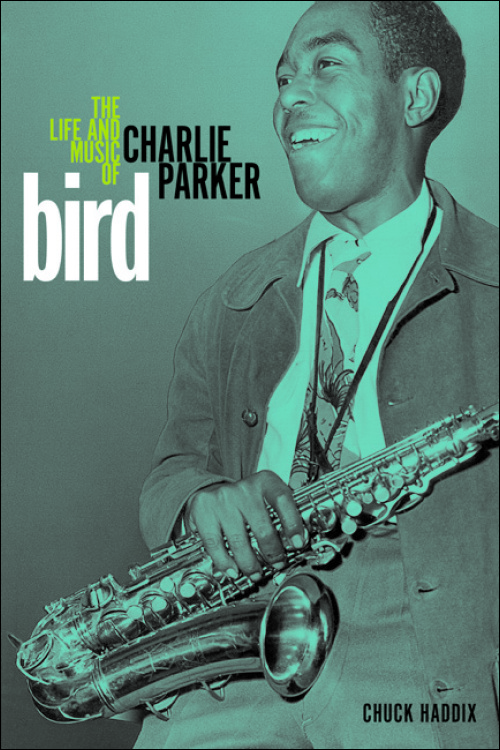
Title = Bird: The Life and Music of Charlie Parker
Publisher = University of Illinois Press
Review=
Charlie Parker (1920-1955) is among the most documented jazz musicians. During a relatively brief recording career (1940-1954), he participated in approximately 250 recording sessions, around 175 as leader. He has been written about extensively, including in books by people with first-hand knowledge of him (such as Ross Russell) and by major critics (such as Gary Giddins). Several Parker discographies have been published. Carl Woideck compiled a collection of writings about him; Ken Vail chronicled his life. Mark Miller detailed his time in Canada. Even a book reproducing his memorabilia has been published. The list goes on. Chuck Haddix’s Bird is one of the most recent books to focus on Parker.
Now, almost sixty years after Parker’s death, a writer needs to have significant new information about—or a fresh approach to--the musician before undertaking a book about him. Because of the author’s research in census records, city directories, and other documents, Bird provides new information, especially about Parker’s early years. All knowledge is good, but the facts Haddix discovered are mostly trivial.
Here are some facts Haddix provides, all of which are new to me. Commenting on the Hannibal Bridge, he notes that “in 1917, at the peak of rail traffic, 271 trains passed daily through Union Station, the massive stone Beaux Arts train station located on the southern edge of downtown” Kansas City, Missouri (7). He records that “as a teenager” in Oklahoma, Parker’s mother “worked as a maid for a household of six headed by Mary H. Morris on Main Street in McAlester, the county seat” (7), and that Parker’s father, “born in 1886,” resided “in a rooming house at 311 West Sixth Street in the heart of a crowded slum on the northern rim of downtown Kansas City, Missouri” (7-8). He observes that Parker played in the band at the 1935 high school graduation of Rebecca Ruffin, who married him the next year; the band performed Elgar’s “Pomp and Circumstance” and the first theme from Coleridge-Taylor’s “An Imaginary Belle” (17). (Does Haddix mean “Scenes from an Imaginary Ballet”?) He pinpoints the location of Musser’s Ozark Tavern, where, in 1936, Parker was en route to play when he was injured in an automobile accident that killed a companion: “three miles south of Eldon, Missouri, at the junction of Highways 52 and 54” (24). Haddix provides numerous addresses, such as those for Kansas City Musicians’ Local 627 (18) and Lucille’s Paradise (28), the Kansas City club where Parker joined the band of Buster Smith.
As the book progresses, the author presents less new information and increasingly treats familiar Parker material: humiliation by Jo Jones, discovering how to create music he had been hearing in his mind by playing “Cherokee” in a new way, various band affiliations, how he became known as Yardbird (later shortened to Bird), the Benzedrine episode with Rubberlegs Williams, the engagement at Billy Berg’s, confinement at Camarillo State Hospital, recording sessions, relationships with wives and Chan Richardson, death in Hotel Stanhope, and so forth. Though he interviewed people who knew Parker, including Jay McShann, Haddix based his treatments of events mainly on secondary sources, such as Robert George Reisner’s Bird: The Legend of Charlie Parker (1962), which includes various people’s recollections of Parker, and Mark Miller’s Cool Blues (1989).
When presenting information from secondary sources, Haddix sometimes seems credulous, as when recounting Parker’s conversation with Einstein (62-63), sleeping under the bandstand during a performance by the Earl Hines band (64), and sleeping all day in a telephone booth (71). These things might have happened, though in each instance Haddix relies on a single source: first, Junior Williams; second, Billy Eckstine (when citing the source of Eckstine’s quotation, Haddix records the wrong page number at n. 12 on 171; Eckstine’s words are from Reisner’s Bird, 85, not 17); third, Art Blakey. Providing another source for each would have bolstered the author’s claims.
Because the sub-title implies full treatment of Parker’s life and music, it misleads: Bird is primarily biographical. When discussing music, Haddix mostly treats externals, as the following illustrates. For Savoy Records, Parker led his first commercial session on 26 November 1945. Haddix notes that Parker composed tunes for it, addresses the confusion over which pianist (Argonne Thornton or Dizzy Gillespie) and trumpeter (Gillespie or Miles Davis) perform on which selections, states that Parker had horn problems, identifies the number of takes for each tune, believes that Parker undermined the session by approaching it haphazardly, and points out that reviewers praised Parker’s solos while “panning the overall result” (83). The author offers what passes for analysis when commenting on “Now’s the Time,” noting only that Gillespie’s altered chords caused Davis to play “out of key” (82), though he does not demonstrate cause and effect. Haddix thinks that this recording highlights “Charlie’s Kansas City roots and deep feeling for the blues” (82), but without explaining how.
Though I acknowledge the difficulty of conveying, in prose, the nature of music, Haddix’s characterization of Parker’s gives little if any sense of its gloriousness—and it is this quality that makes the saxophonist’s life worth documenting. Haddix does not even mention that Parker’s solo on “Ko Ko” (from the “Now’s the Time” session) is widely considered one of the most impressive and important solos in jazz history. It is so highly regarded that it was in the first group of recordings selected for the National Recording Registry at the Library of Congress (see item 36 at http://www.loc.gov/rr/record/nrpb/registry/nrpb-2002reg.html; accessed 24 February 2014). The Library of Congress justifies its inclusion by stating that it “signaled the birth of a new era in jazz—bebop.” Though the accuracy of this claim can be debated, Haddix ignores the recording’s significance. To him, it is just another Parker recording. He also fails to indicate that two of the tunes Parker wrote on the spur of the moment for this session—“Billie’s Bounce” and “Now’s the Time”--are so appealing that each has been recorded hundreds of times. They are part of the jazz repertoire, as anyone who has listened to much jazz can attest. (Ted Gioia identifies them as such in The Jazz Standards [2012].) “Billie’s Bounce” was inducted into the Grammy Hall of Fame (2002). In other words, Haddix does not attempt to do justice to Parker’s music.
This book needed copy editing. For example, Haddix writes “fed up towing the Jim Crow line” (69; the correct word is “toeing”) and “he was getting ringing wet” (72; “wringing”). Because he quotes the latter correctly from a published source, “[sic]” should have been inserted after “ringing” to indicate awareness—if there was awareness--of the error in the source material, an interview with trombonist Trummy Young. Singer Ethel Waters is identified as Ethyl (77). Haddix twice states that the Kansas City Call was an African American newspaper (17, 28) and four times notes that Emry Byrd was known as Moose the Mooche (86, 95, 146, 184). The given name of John S. Wilson is misspelled (171, n. 29). No publication date is provided for Chan Parker’s My Life in E-Flat (172, n. 41). The index identifies the radio program Bands for Bonds as Bands for Bond and alphabetizes Ross Russell according to his given name. Though relatively unimportant, these and other infelicities should not occur in a book published by a major university press.
Well-written and generally accurate, Bird will benefit readers who desire an overview of the musician’s life and career. Those already familiar with Parker will learn from it primarily specifics about his early years, such as addresses of various places. It is not the book to consult for significant new biographical information or for a discussion of or insight into his music.
Author = Benjamin Franklin V
 Date = 21 February 2014
Artist Name = Art Pepper
Genre = Jazz
Title = Unreleased Art, Vol. VIII: Live at the Winery, September 6, 1976
Record Company = Widow’s Taste
Review =
Johnny Hodges, Benny Carter, Charlie Parker, Ornette Coleman—these and perhaps one or two others rank as the major jazz alto saxophonists. If they receive the grade of A, Art Pepper probably deserves A-. Inventive, impassioned, and technically adroit, he played in an appealing individual style. Over almost four decades (from 1943 until 1982, the year he died), he recorded mostly at a high level, though he was off the scene in the mid 1950s and for most of the first half of the 1960s while incarcerated for heroin addiction, twice in San Quentin. He rehabbed at Synanon.
Though Pepper was not underrecorded, his widow, Laurie Pepper, has issued a series of his previously unreleased performances on Widow’s Taste, most recently Live at the Winery. I cannot think of a Pepper album that better demonstrates his skills. It has flagwavers and sensitive ballads, as well as a blues, all performed by a musician playing at his best, which is something of a miracle, given his troubles along the way. Recorded in 1976 in Saratoga, CA, these performances are emotional, even highly so on one selection.
On the middle-groove, gritty “Saratoga Blues,” Pepper demonstrates his facility with the twelve-bar format. At the end, he is especially effective when hinting at Charlie Parker’s “Parker’s Mood” but not actually quoting from it. Some people applaud the tendency of soloists (Dexter Gordon, for example, and Parker himself) to quote from other tunes; I find it lazy, an unsatisfactory substitute for invention: Can’t think of anything original? Then quote from another tune.
There are three swingers. “Caravan” and “What Laurie Likes” are intense. Evidencing the influence of John Coltrane, Pepper plays a long introduction before getting to the melody of the former. The group plays the latter, melodically similar to Bobbie Gentry’s “Ode to Billie Joe,” in a funk groove, with a bow to Roland Kirk toward the conclusion. Yet “Straight Life,” one of Pepper’s signature tunes and the title of his autobiography (written with Laurie Pepper), is the performance that will most attract listeners who like music performed way up-tempo. This reworking of “After You’ve Gone” is played so fast that one marvels at bassist Jim Nichols’s ability to keep the beat and at Pepper’s to create.
Though not precisely a ballad, “Ophelia” is far more subdued than the swingers. Pepper states that he wrote it in order to capture various aspects of women, including their madness and beauty (an obvious reference to Ophelia in Hamlet). I cannot determine the degree to which he succeeds. It is, in any event, an attractive composition and performance. “Here’s That Rainy Day” is not only a ballad, but it approaches Frank Sinatra’s 1959 version as the most poignant recording of this song. Pepper’s interpretation ranks, in my judgment, with Miles Davis’s “It Never Entered My Mind” (1956) as among most supernal modern jazz ballad performances. Pepper was so moved by pianist Smith Dobson’s solo that he almost chokes up when talking about it after the music stops. He goes so far as to say that Dobson’s solo could serve as a definition of jazz: “That’s what they’re talking about when they say ‘jazz.’” While Dobson’s solo is beautiful, Pepper’s impassioned playing is even more impressive. Some soloists, such as Lester Young, insist on knowing the lyrics to tunes they play so they can faithfully render the emotions the words express. On “Here’s That Rainy Day,” Pepper conveys the sadness and introspection—even the agony--of someone suffering from lost love.
Live at the Winery is spectacular in every way, so much so that it might be Pepper’s most rewarding album.
Author = Benjamin Franklin V
Copyright © 2012 – 2014 Music Charts Magazine® - (www.MusicChartsMagazine.com) – All Rights Reserved. Contents of this site including text and media may not be reproduced without prior written consent. Audio and video elements of this site are property of their respective owners and are used with permission.
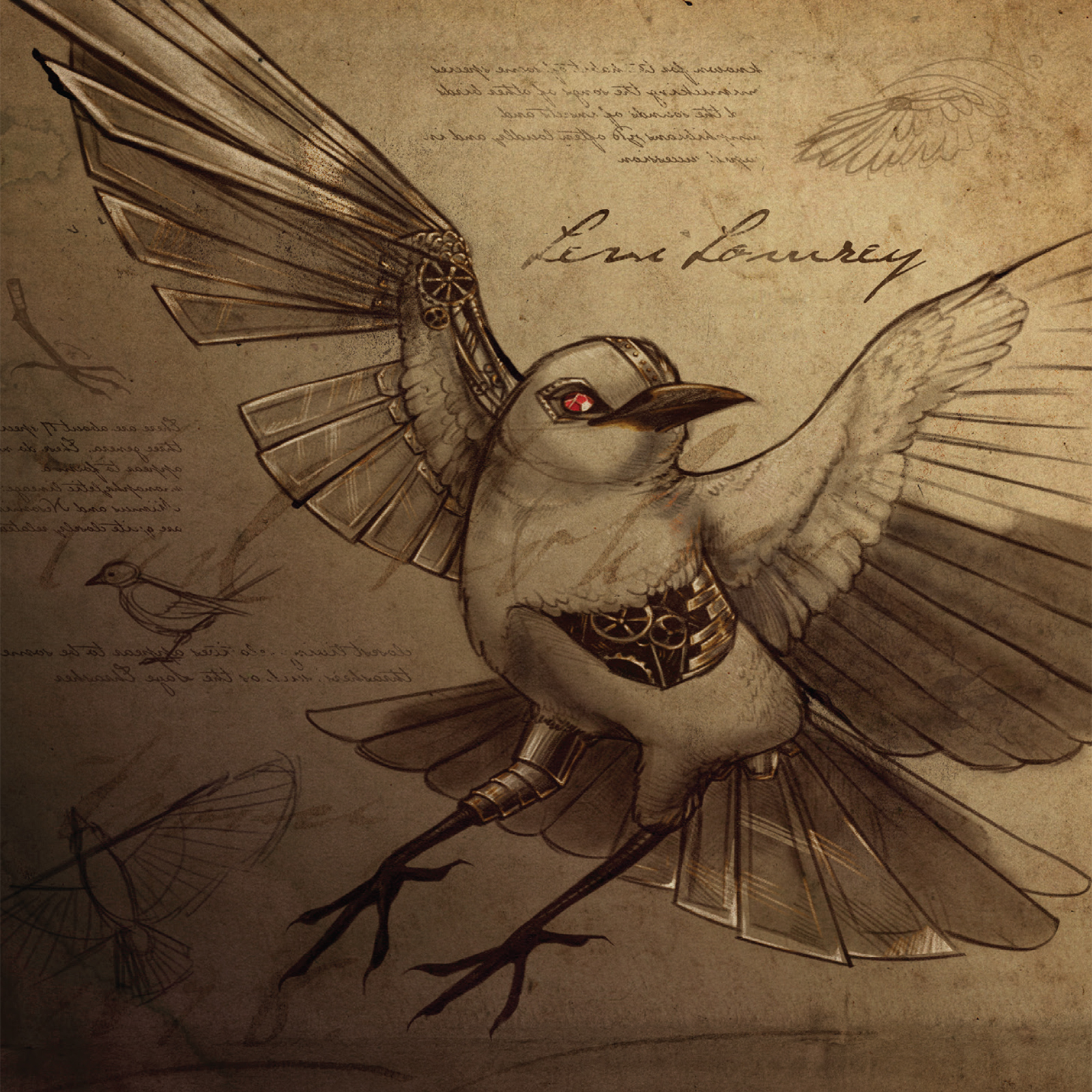 Anyone who is a fan of the Zac Brown Band might be familiar with the name Levi Lowrey. Levi co-wrote the Zac Brown hit, “Colder Weather”. On Feb. 25, 2014, Levi will release his self-titled, sophomore album through Zac Brown’s Southern Ground Artists.
I first heard Levi when he opened for Zac Brown Band in Kingsport a few years ago. I enjoyed his performance. But somehow, he then fell off my radar, and I lost contact with this great artist. I am glad he is back on my playlist. While Levi may not be your typical country artist, he definitely gives us some of the best country music you will ever hear. His sound and writing have been described as ‘one of a kind,’ and you don’t have to listen long to know that is true.
As I listened to the new album, I found myself getting into the lyrics more than I usually do. The songs make you think, and you just know how much the words mean to the writer. When you get to the end of a song, you are probably going to want to start that same song again, to study it, and learn it, and really listen to it before moving on to the next one.
“December Thirty-One” is one of my favorite songs on this album. This song isn’t just about Dec. 31. It’s about Dec. 31, at 11:59 p.m. We’ve all been there. One year is ending, a new year is about to begin. There’s a lot to look forward to, and there’s a lot to remember. When you couple memorable lyrics with a great melody, you have a hit record. I would love to hear this one on country radio. I have no idea what Levi’s plans are for putting a single out on country radio, but this is the one I would like him to consider.
There are 15 tracks on this album, with a total time of a little more than an hour. When you think you’ve heard the best one, you probably haven’t. Because when the next song begins, you will find out it is just as good as the one you just heard - and is some cases, even better. Out of all the songs, the last one, “War Pigs,” is the only one I didn’t think fit with the rest of what Levi had to offer. It’s fast, it’s loud, it is a little weird. “War Pigs” is the only song I will probably not listen to over and over again. I know there are people who are going to love that song. But I believe, to thoroughly enjoy 14 out of 15 songs on a CD is quite an accomplishment for the artist.
“When it comes down to the end, are you living, my friend – of just trying your best not to die?”. That is a question Levi asks in the third track, “Trying Not To Die”. Every song on this album gives you something to think about. And you are going to relate something you hear, to something you’ve done, or something that has happened sometime during your life.
The 15 songs you will get on Levi’s album are Picket Fences, December thirty-One, Trying Not to Die, High and Lonesome, That is All, Before the Hymnal Died, I’ve Held the Devil’s Hand, Urge For Leaving, Window Pane Soul, What She Don’t Know, Barely Getting By, Don’t Blame Me, Long Way Home, Flywheel and War Pigs.
All of the songs, except one, are original, and the CD features Levi working with a lot of guest musicians. Clay Cook, from Zac Brown Band; Ross Holmes, fiddler for Mumford and Sons/Cadillac Sky); and Oliver Wood from The Wood Brothers all help to make this album what it is. Ad Mac McAnally, performer, producer and Nashville Songwriters Hall of Fame inductee to that list, and of course the fact that the album was produced by Zac Brown, and co-produced by Matt Mangano and Clay Cook, and there is no way this new project is going to be anything but great listening.
This is an album that belongs in the collection of every country music fan. It is one of the best albums I’ve heard in a long time. We’ve got an artist here who has produced 15 songs, and not one of them sounds like rock, pop or rap.
You can keep up with all the news about Levi on his web site, www.levilowery.com, and follow him on Twitter @levilowrey. And remember, for all of your country music news and reviews, visit our site, www.countryschatter.com, and follow us on Twitter @countryschatter.
 Date = 2 February 2014
Genre = Jazz
Title = Delmark: 60 Years of Jazz
Record Company = Delmark
Review =
I admit to fondness for samplers, albums containing selections from various LPs or CDs released by a single company. They are compiled to present highlights from the catalogue, or at least to provide representative selections, in the hope that listeners will buy the albums from which the selections come. Among the many impressive ones are Jazz at Columbia—Swing (1956); The Blues in Modern Jazz, which Atlantic issued in 1961; and Blue Note Gems of Jazz (1967). A decade after its two-CD 45 Years of Jazz and Blues (1998), Delmark released 55 Years of Jazz and 55 Years of Blues. Its 60 Years of Jazz appeared in late 2013. This sampler reminds listeners that Delmark is one of the few jazz record companies active in the 1950s that is still in business as an independent concern. Atlantic, Blue Note, Contemporary, Fantasy, Prestige, Verve—these and other venerable labels continue operating, but as parts of conglomerates, such as Universal Music. Appealing music, though, is the major reason for purchasing this CD.
Born in 1932, Bob Koester founded Delmar Records in St. Louis in 1953, naming the business for its location, Delmar St. Sometime after moving to Chicago in 1958 to be near a thriving blues scene, he renamed his label Delmark. It is noted for a strong blues catalogue featuring recordings by Jimmy Dawkins, J. B. Hutto, Magic Sam, Otis Rush, Speckled Red, Junior Wells, and Big Joe Williams, among others. In jazz, it is important as the first company to record musicians affiliated with the Association for the Advancement of Creative Music (AACM), which did, indeed, advance creative music; Delmark also distributed early recordings by Sun Ra. Though it remains independent, Delmark has become something of a mini-conglomerate as a result of Koester’s having bought the recordings of other labels, including Apollo, Paramount, Parkway, Pearl, Regal, Sackville, States, and United.
Nine of the twelve selections on Delmark: 60 Years of Jazz were recorded in this century; the others are from 1947 (Eddie “Lockjaw” Davis), 1952 (Dewey Jackson), and 1969 (Sonny Stitt). The Davis recording, an alternate take, is issued here for the initial time, as is a tune recorded in 2013 by the Fat Babies. Koester is partial to early jazz, which is represented here by trumpeter Jackson (a professional by 1912) and the Fat Babies. Musicians associated with AACM are not present, but Jason Adasiewicz’s trio plays in what might be called a quasi avant-garde mode. Groups led by Ernest Dawkins, Red Holloway, Rob Mazurek, Nicole Mitchell, and Ira Sullivan perform more traditionally.
Two selections combine free and more restrained playing. One, Kahil El’Zabar’s “Crumb-Puck-U-Lent,” has a steady beat, but the solos by tenor saxophonist Ari Brown and violinist Billy Bang are somewhat “out.” The other, cornetist Josh Berman’s “Sugar,” is, to me, the most impressive performance on the CD. Composed in the mid 1920s by Maceo Pinkard, Edna Alexander, and Sidney D. Mitchell, “Sugar” has been recorded hundreds of times and was the signature song of Lee Wiley. Berman’s version is unlike any I have heard. Initially cacophonous and halting but settling into a groove behind the gritty soloing of tenor saxophonist Keefe Jackson, the group plays largely “out” for two-and-a-half minutes before introducing the melody, which it plays in unison for only sixteen bars. Bass clarinetist Jason Stein begins soloing at the start of the bridge and dominates for most of the remainder of the performance. Drummer Frank Rosaly solos briefly before the group concludes not with a restatement of the melody but rather by reverting to the manner of the long introduction. This is a daring, thrilling recording during which the leader does not solo.
This CD will interest people curious about the history of independent record companies and listeners who enjoy stimulating improvised music. Concurrent with this release, Delmark issued Delmark—60 Years of Blues, though I cannot comment on it because I have not heard it.
Author = Benjamin Franklin V
Copyright © 2012 – 2014 Music Charts Magazine® - (www.MusicChartsMagazine.com) – All Rights Reserved. Contents of this site including text and media may not be reproduced without prior written consent. Audio and video elements of this site are property of their respective owners and are used with permission.
Date = January 24th, 2014
Artist Name = Ali Ryerson
Genre = Jazz
Title = Game Changer
Record Company = Capri
Review =
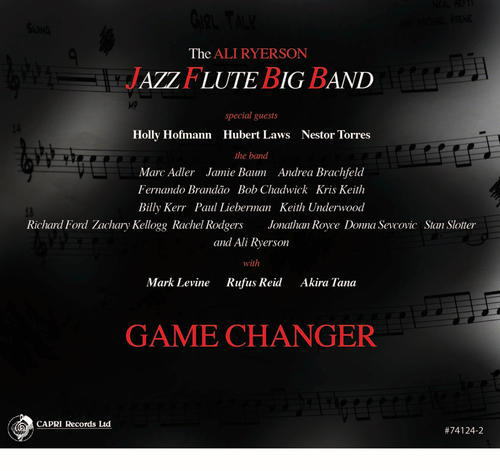
For at least six decades, some jazz recordings have featured multiple instruments of the same family. Beginning in the mid 1950s, for example, a vocal group released albums titled The Four Freshmen and Five Trombones, The Four Freshmen and Five Trumpets, The Four Freshmen and Five Saxes, and The Four Freshmen and Five Guitars. In 1956, Columbia released J. J. Johnson and Kai Winding’s Jay & Kai +6, with eight trombonists. The next year, Art Blakey recorded an album (Orgy in Rhythm) featuring nine percussionists. A few years later, Warner Brothers issued LPs by groups known as Guitars, Inc; Saxes, Inc.; and Trombones, Inc. The first includes five guitarists; the second, thirteen saxophonists; the third, twenty trombonists, though only ten play at a time. Beginning in 1977, Odean Pope released several albums by his saxophone choir, usually consisting of nine saxophonists. At a session presumably led by Jane Bunnett, the Havana Flute Summit recorded an album with four flautists (1996). This number of flutes is modest when compared with the nineteen on Ali Ryerson’s Game Changer (2012), possibly the most recent recording featuring many musicians playing the same kind of instrument, or variations of it.
Ryerson had to confront the issue of how best to attain tonal diversity in music played by a band of flutes. She did so by employing several types of the instrument: C, alto, bass, and contrabass. One musician doubles on piccolo. She engaged six arrangers who helped provide variety by writing engaging voicings and occasionally dividing the flutes into two sections, with one playing the melody while the other supports it, as frequently happens between reeds and brass in a typical big band. Ryerson and the arrangers added texture by allotting solo space to members of the rhythm section--pianist Mark Levine, bassist Rufus Reid, and drummer Akira Tana. These tactics help—and the multitude of flautists adds body--but the overall sound remains, understandably, thin. It seems less so when the band backs a soloist, primarily because the large group is then of secondary interest. Sometimes, it rests during a solo.
Despite this issue, Ryerson’s CD has much to recommend it, including the hip tunes it plays. Aside from Gabriel Fauré’s  “Pavane” (which has been recorded by Bill Evans and other improvisers), they are all by jazz musicians: Clifford Brown’s “Daahoud,” Wayne Shorter’s “Ana Maria,” Oliver Nelson’s “Stolen Moments,” Herbie Hancock’s “Speak Like a Child,” Dizzy Gillespie’s “Con Alma,” John Coltrane’s “Impressions,” Tom Harrell’s “Sail Away,” and Neal Hefti’s “Girl Talk” and “Lil’ Darlin’.”
While hip tunes appeal, what matters is how they are interpreted and performed. Because the band plays what the arrangers wrote, they are the major interpreters, and their creations are uniformly attractive. Ryerson employed six of them: Billy Kerr (who also performs on flute), Mark Levine, and Steve Rudolph, who were responsible for one tune each, plus Michael Abene (two tunes), Bill Cunliffe (two), and Mike Wofford (three). Consider “Ana Maria.” On Shorter’s original recording, the soprano saxophonist is the only soloist, and mostly he plays the melody. Wofford’s lush arrangement emphasizes the tune’s chords and inherent loveliness while allowing for solos by bassist Reid and, on alto flute, Marc Adler. Wofford’s interpretation is every bit as valid as the composer’s version and is, if anything, more pleasing, at least to me. Or consider “Con Alma,” for which Cunliffe provides a new introduction (new to me, anyway). About half-way into the piece, following Nestor Torres’s solo on C flute, the performance all but stops, then resumes with original Cunliffe material played in a more sprightly manner than the first part. Following a brief solo by drummer Tana, the music again halts before returning to Gillespie’s melody. That is, Cunliffe offers an idiosyncratic version of “Con Alma” that keeps the listener expecting the unexpected. In other words, these and the other arrangements are inventive and well suited for the group that plays them. And the musicians perform the arrangements as directed: they never falter; they are professionals. Plus, the three guest flute soloists—Holly Hofmann (C flute), Hubert Laws (alto), and Torres (C), each of whom solos once—are good improvisers. At least I assume they improvise, as opposed to playing written solos.
Because of Ryerson’s musical vision for this band of odd instrumentation, because of the excellent arrangements of attractive tunes, because of the musicians’ ability to perform well, and because of the nature of the solos, I recommend this CD. Ultimately, the unavoidable thin sound—which is ameliorated somewhat by strategic planning--matters little.
Author = Benjamin Franklin V
Music Charts Magazine ™ - Album & Artist Reviews
Date = 18 January 2014
Artist Name = Ed Reed
Genre = Jazz
Title = I’m a Shy Guy
Record Company = Blue Shorts
Review =
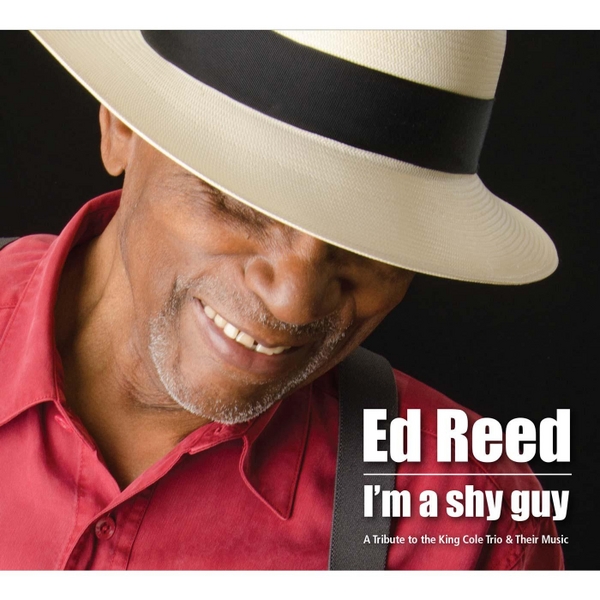
Many jazz musicians have had odd careers. Active in the 1930s, alto saxophonist Boyce Brown left music to become a friar; as Brother Matthew, he recorded once, in 1956. Trumpeter Don Joseph recorded off and on during the 1950s, but only once subsequently, in 1984, presumably because of poor health. Frustrated with his playing, Sonny Rollins took two sabbaticals, one in 1959 to practice for three years, and another in the early 1970s to study Eastern thought. Craig Hundley (now Huxley) had an acting career before leading his first recording session at age fourteen; he became a classical pianist, composer, and film producer. One of the strangest careers is that of singer Ed Reed. Though born in 1929, he did not record until 2006. This delay occurred partly because he was a junkie for forty years, beginning in the 1940s, and was incarcerated during the 1950s and 1960s; he sang in a prison band. As best as I can tell, he was musically inactive during the 1970s and 1980s, possibly because of drug problems. Clean since 1986, he resumed singing in the early 1990s. Despite his age and the toll drugs doubtless took on him, his voice seems unaffected. I would characterize it as robust and supple, free from the thinness and quavering that often affect an octogenarian. Someone listening to Reed without knowing his age might think him in his forties.
On his four CDs, Reed performs good tunes that typically have not been overworked. Ed Reed Sings Love Songs (2006) features pieces associated with Duke Ellington (“A Flower Is a Lovesome Thing,” “Daydream”), Thelonious Monk (“Ask Me Now”), and Billie Holiday (“If the Moon Turns Green,” arranged by Carmen McRae). It concludes with an a cappella version of “Motherless Child,” on which he stays in tune. The Song Is You (2007) is jazzier than the first CD because of the space allotted to the Peck Allmond Sextet, which backs the singer, as it does less prominently on Ed Reed Sings Love Songs. Of the eleven selections on The Song Is You, four are by Ellington (“All Too Soon,” “Don’t You Know,” “I Didn’t Know about You,” and “It Shouldn’t Happen to a Dream”). Yet the brief “I’m Through with Love” (2:22) is perhaps the most impressive track because Reed, backed only by guitarist Jamie Fox, sings it through but once, letting simplicity, vocal quality, and emotion make it moving and memorable; anything additional would be superfluous. He sings three songs recorded by Bill Henderson, who influenced Reed (“Don’t Like Goodbyes,” “It Never Entered My Mind,” and the title tune); he performs another one, “Never Kiss and Run,” on his next release, Born to Be Blue (2010). On it, his song selection is typically attractive, though he sings one tune that is grittier than his usual fare, Big Joe Turner’s “Wee Baby Blues.” These three CDs have been warmly received by the jazz press, as, probably, will be his most recent release, I’m a Shy Guy (2013).
Despite critical acclaim, Reed seems little known outside the cognoscenti, possibly because he sings old songs (mostly standards) in an old style when listeners, especially young ones, favor the new: he respects lyrics, enunciates clearly, and improvises by taking melodic liberties. These are, though, desirable, admirable qualities, ones well suited for the kinds of songs Reed prefers, including those on I’m a Shy Guy, on which he sings tunes recorded by Nat Cole’s trio in the 1940s, plus two pieces Cole recorded with the backing of large groups, “’Tis Autumn” (1949) and “Unforgettable” (1956).
Reed follows Cole’s example by taking most of the songs at a relaxed medium tempo. Because of his playfulness and solos by saxophonist Anton Schwartz, pianist Randy Porter, and Fox, the bouncy “Straighten Up and Fly Right” is one of the least restrained performances. “That Ain’t Right” is a blues. The longest track, its amusing lyrics about a gold-digging woman might have inspired Ray Alfred’s lyrics for “I’ve Got News for You” about a two-timing woman. On “That’s the Beginning of the End,” Reed makes believable the advice of a former lover to a woman’s current one. “This Will Make You Laugh” and “I’m Lost” feature Reed backed by a single instrumentalist—Fox on the first, bassist John Witala on the second. Because of the intimacy of each, these two performances are highlights.
The rueful “Baby Baby All the Time” reminds listeners that Bobby Troup wrote a successful song other than “Route 66” (several of his compositions endure, including “You’re Looking at Me,” which Reed performs on Born to Be Blue). It is the sole tune Reed sings on I’m a Shy Guy that Diana Kral sings on her CD of Cole material, All for You (1995). This release, her third, catapulted her to fame in her early thirties. I hope that Reed’s CD of music associated with Cole serves him similarly in his mid eighties.
Author = Benjamin Franklin V